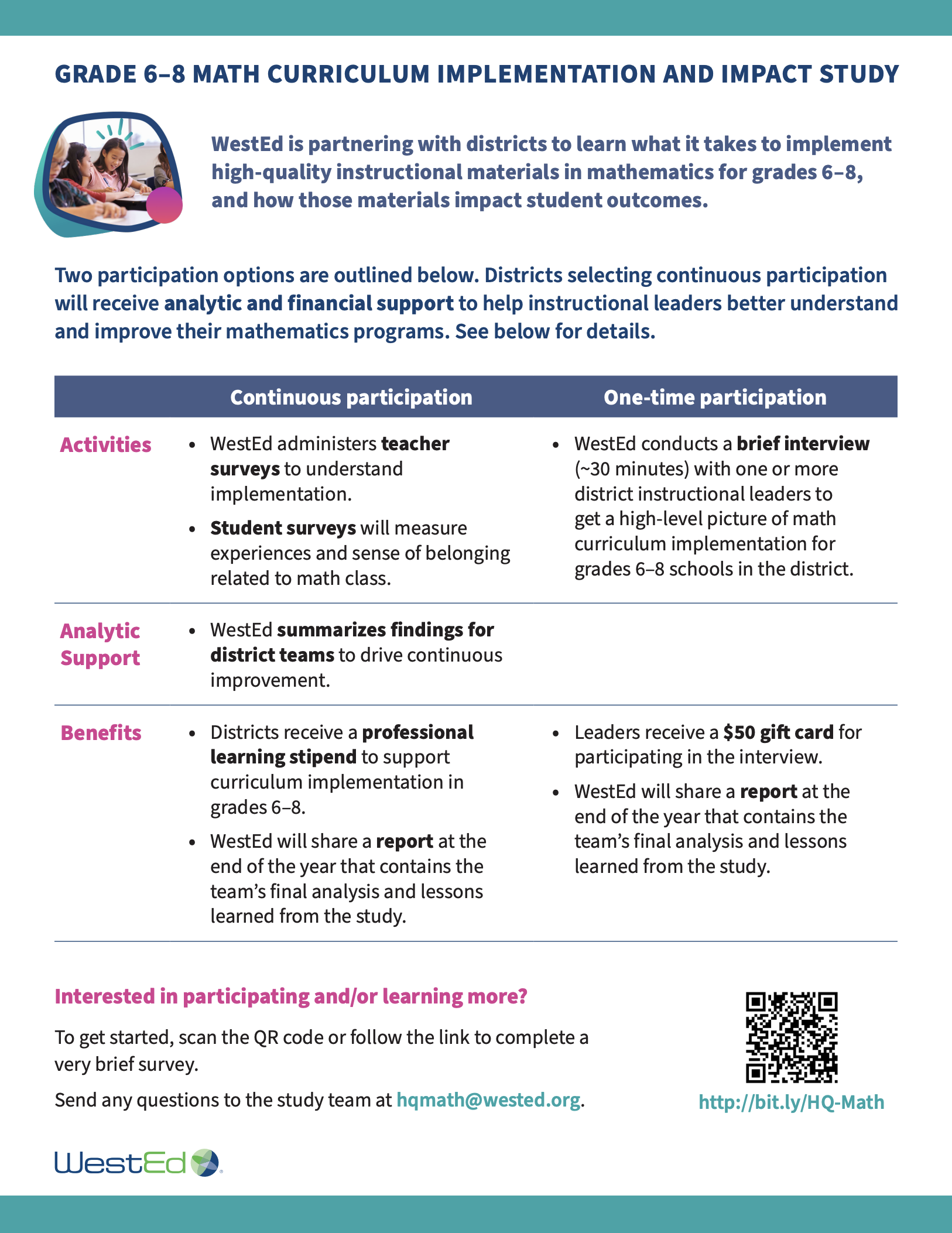
Overview of the Illustrative Mathematics® Efficacy Study
WestEd is partnering with districts and schools to build evidence about what works in middle school mathematics. Over 4 years, WestEd researchers are examining how implementing Illustrative Mathematics (IM) and other high-quality mathematics curricula affects student outcomes, both academic and attitudinal. We’re also exploring what district and school supports help ensure curricula are implemented as intended. This work is generating practical insights for educators and critical evidence for the broader math education and standards-based reform communities.
Strengthen Your District’s Math Teaching and Learning
Implementing a math program takes time, resources, and ongoing support. Needs vary across teachers, classrooms, and schools. Join WestEd’s Illustrative Mathematics Efficacy Study and get needed supports:
- Professional support for instructional leaders
- Resources for grades 6–8 educators
- Data to understand and improve implementation
Through fall 2026, we are recruiting districts using Illustrative Mathematics and other high-quality middle school math curricula to understand how implementation affects student outcomes.
Study Eligibility
There are two ways to participate.
One-time participation. Does your district
- use high-quality mathematics instructional materials in grades 6–8?
- have a math leader available for a short virtual interview?
Continuous participation. Does your district
- want to better support curriculum implementation?
- have at least three middle schools serving grades 6–8?
- have the availability to participate through the 2026–27 school year?
- commit to meeting the needs of Black and Latinx students and all students experiencing socioeconomic challenges?
Sign up to learn more about enrolling your district.
For Continuous Participation Districts
Benefits
- Professional development resources to support math curriculum implementation
- Data and measurement support from WestEd researchers—including implementation, student attitudes, and achievement
- Aggregated implementation data to support continuous improvement with regular debrief conversations with WestEd researchers
- An end-of-project summary highlighting bright spots and sustainability recommendations
Study Timeline
- Summer 2023–Fall 2026
Recruitment. - Fall 2024–Fall 2026
Districts join on a rolling basis. Continuous district partners kick off with an initial meeting and data collection. - Fall 2024–Spring 2027
Ongoing data collection. WestEd shares data back to continuous district partners and meets regularly to discuss findings and improvement actions. - Spring 2027
Study ends.
Commitments
Continuous participation schools and districts sign a Memorandum of Agreement (MOU) committing to the study and data collection. The burden on teachers and students is minimal. In 2026–27, all teachers in grades 6–8 will complete three surveys about their instructional practice and will administer two student surveys. The heart of the work centers around collaborating with district math leaders to examine implementation data and identify actions for improvement.
Here are the specifics:
Districts: Sign an MOU covering administrative data—professional development provision and costs; student demographics and mathematics achievement; and curriculum implementation data—along with data from administrators, teachers, and students. Districts receive an annual professional-learning stipend, paid during the 2026–27 school year:
- 3 participating schools: $2,500
- 4–5 participating schools: $5,000
- 6–12 participating schools: $15,000
- 13-plus participating schools: $20,000
District Mathematics Leads: For districts opting for continuous participation, a small team (about 4 people) of district math leaders will do the following:
- Attend one 90-minute in-person or online kickoff meeting with WestEd researchers
- Hold two 2-hour meetings per year to discuss implementation data and findings
- Support study data collection
Data team members receive a $1,500 annual stipend for attending all meetings. Select members may also be asked to participate in a compensated 1-hour interview.
Principals: May be asked to participate in a compensated 1-hour interview about their school’s curriculum implementation context.
Teachers: Each year, all participating teachers in grades 6–8 will do the following:
- Complete three surveys about instructional practice
- Administer two student surveys
Selected teachers may participate in a focus group once per year. All participating teachers sign consent forms.
Students: Students of consenting teachers complete two surveys per year—one in fall, one in spring.
